
About PALAESTRA
PALAESTRA strengthens CBRNe preparedness through realistic, adaptable, and operationally grounded training and simulation.
Project Background
PALAESTRA addresses critical gaps in the way CBRNe training is designed, delivered, and evaluated across Europe. First responders, medical services, and supporting organisations operate in complex, high-risk environments where preparedness depends not only on equipment and procedures, but on realistic, adaptable, and operationally grounded training.
Current CBRNe training approaches often struggle to reflect real-world complexity, cross-agency coordination, and evolving threat scenarios. They can be time-consuming to prepare, difficult to adapt to different operational contexts, and limited in their ability to support joint training across disciplines and borders. PALAESTRA responds to these challenges by placing operational end users and trainers at the centre of the training design process.
The project brings together practitioners, training organisations, technology providers, and research partners to co-design a next-generation training and simulation platform. By grounding development in real operational workflows and user-identified needs, PALAESTRA aims to strengthen preparedness, interoperability, and resilience across the full CBRNe incident lifecycle.

Project Objectives
- Capture and prioritise end-user needs for CBRNe training across response, medical, and coordination roles.
- Design and validate realistic training scenarios that reflect operational constraints, decision-making pressures, and cross-sector dependencies.
- Enable modular, reusable, and adaptable training content to reduce preparation time and support diverse training contexts.
- Support multi-agency and cross-border training through interoperable, scalable simulation approaches.
- Integrate advanced digital technologies, including AI-assisted scenario generation and simulation orchestration, to enhance realism and flexibility.
- Evaluate training effectiveness and impact, supporting continuous improvement and evidence-based decision-making.
The CBRNe Casualty Journey
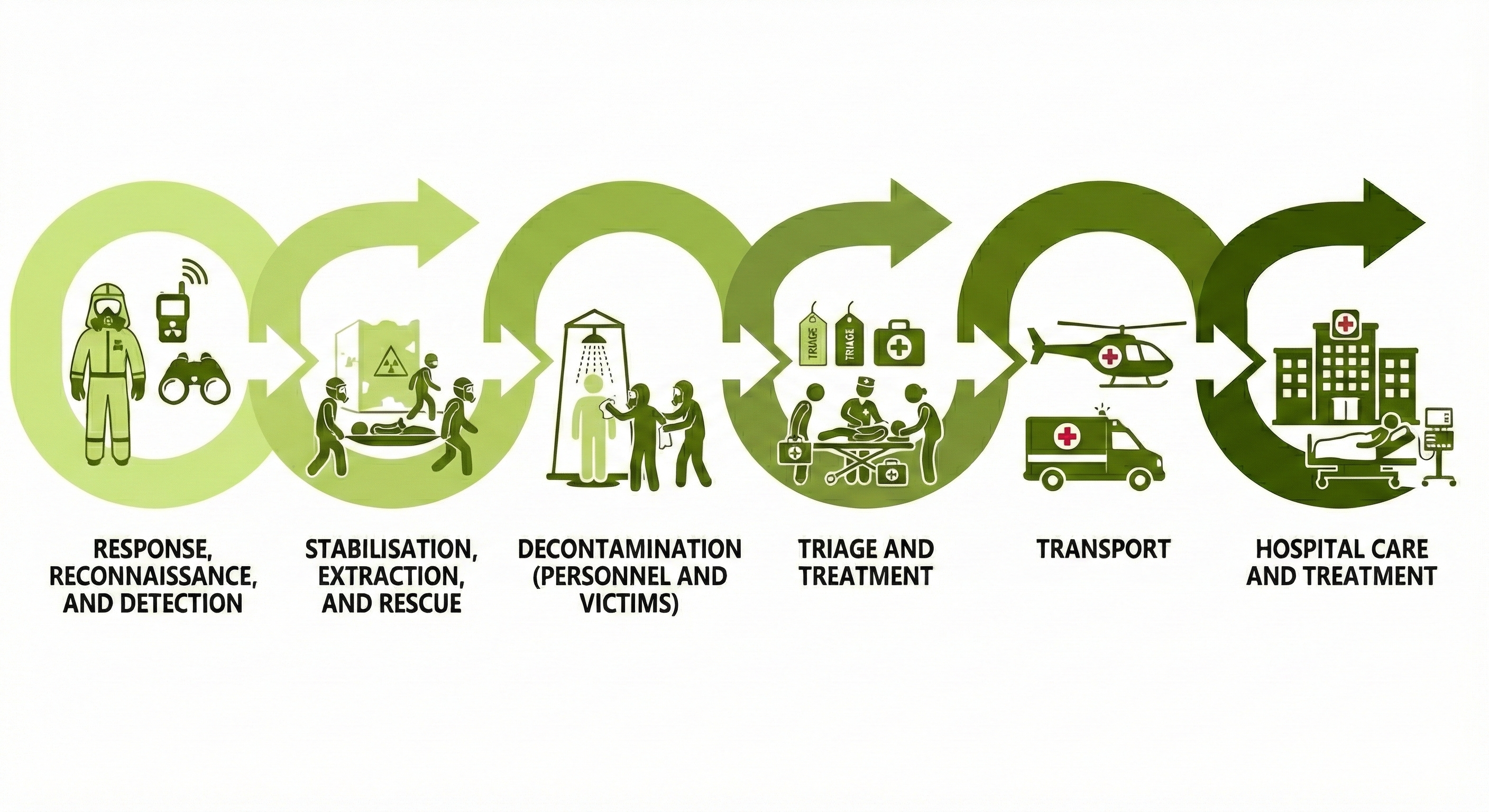
In a CBRNe incident, casualty outcomes depend on a chain of actions that begins at the scene and continues through hospital care. This casualty journey spans detection, rescue, decontamination, triage, transport, and treatment — with each stage shaping what is possible in the next. Hospitals are not a standalone solution; they rely on earlier responders doing their job correctly.
Why Training This Is Hard
Each stage of the casualty journey involves different actors,
procedures, and decision pressures, all operating under severe
time and safety constraints. Actions are interdependent, and
small errors early on can have major consequences later.
Traditional training often isolates tasks and roles, making it
difficult to reflect the full operational reality of a CBRNe
incident. Training the entire journey requires realistic,
connected scenarios that capture coordination, timing, and
cascading effects — which is why it remains one of the most
complex challenges in responder training.
Why Training the CBRNe Lifecycle Is Hard
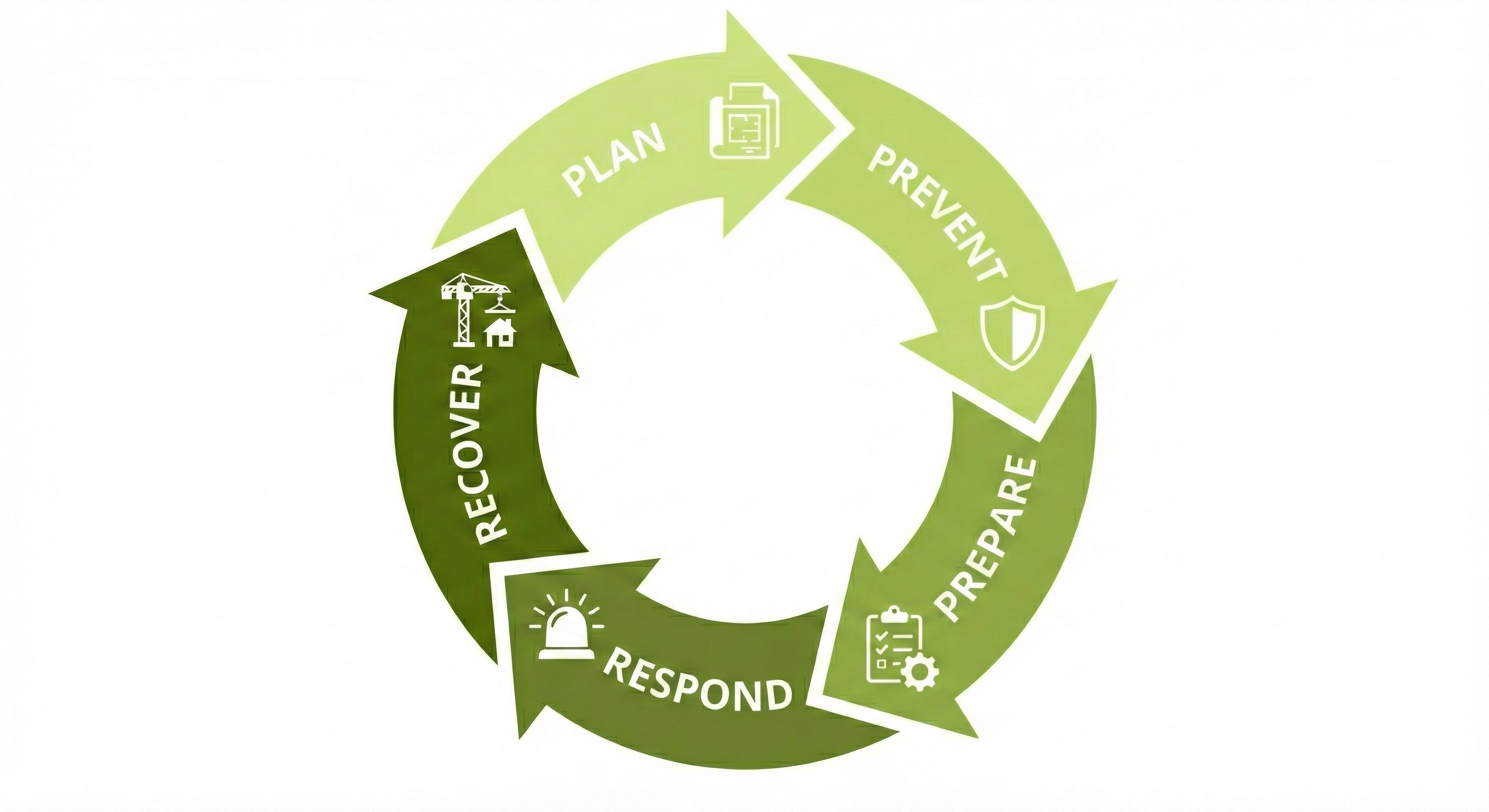
CBRNe readiness isn’t trained in a single moment — it’s built across a connected lifecycle. Each phase has different objectives, skills, and pressures, and mistakes in one stage ripple into the next.
Planning must turn lessons into action. Prevention relies on spotting risks before they escalate. Preparation depends on coordination across agencies that rarely train together. Response demands rapid decisions under extreme uncertainty, while managing detection, protection, and decontamination. Recovery extends long after the incident, feeding critical lessons back into future plans.
The challenge is not training each phase in isolation — it’s training how they connect. Realistic CBRNe training must capture this flow, showing how decisions compound across the lifecycle, under real operational constraints.
Project Facts

Project Methodology
PALAESTRA follows a user-centred, iterative methodology built around co-design, validation, and continuous feedback from practitioners.
Key methodological principles include:
- Early and sustained end-user involvement, ensuring relevance and operational credibility
- Scenario-driven design, grounded in real incident workflows and constraints
- Iterative development and validation, combining technical development with training trials
- Cross-disciplinary integration, spanning response, medical care, coordination, and recovery
Rather than prescribing a single training solution, PALAESTRA focuses on building a flexible framework that can evolve alongside operational needs and emerging threats.
Expected Impacts
- Improved preparedness and decision-making for CBRNe responders and medical personnel
- Reduced training design effort through reusable and adaptable scenario components
- Enhanced interoperability across agencies, sectors, and national boundaries
- Stronger alignment between training, operations, and technology development
- A sustainable foundation for future CBRNe training innovation in Europe
"Effective CBRNe response depends on what happens before the incident - in training, coordination, and decision-making."